Wall Art Guide, Wall Art Tutoriels
KAWS Wall Art: Street Artist Companion Collectibles
Jun
So I’ve been collecting KAWS pieces for about three years now and honestly it started because a client wanted something “edgy but not too street” for their loft and I went down this whole rabbit hole. Now half my living room has these Companion figures staring at me while I watch Succession reruns.
Understanding What You’re Actually Buying
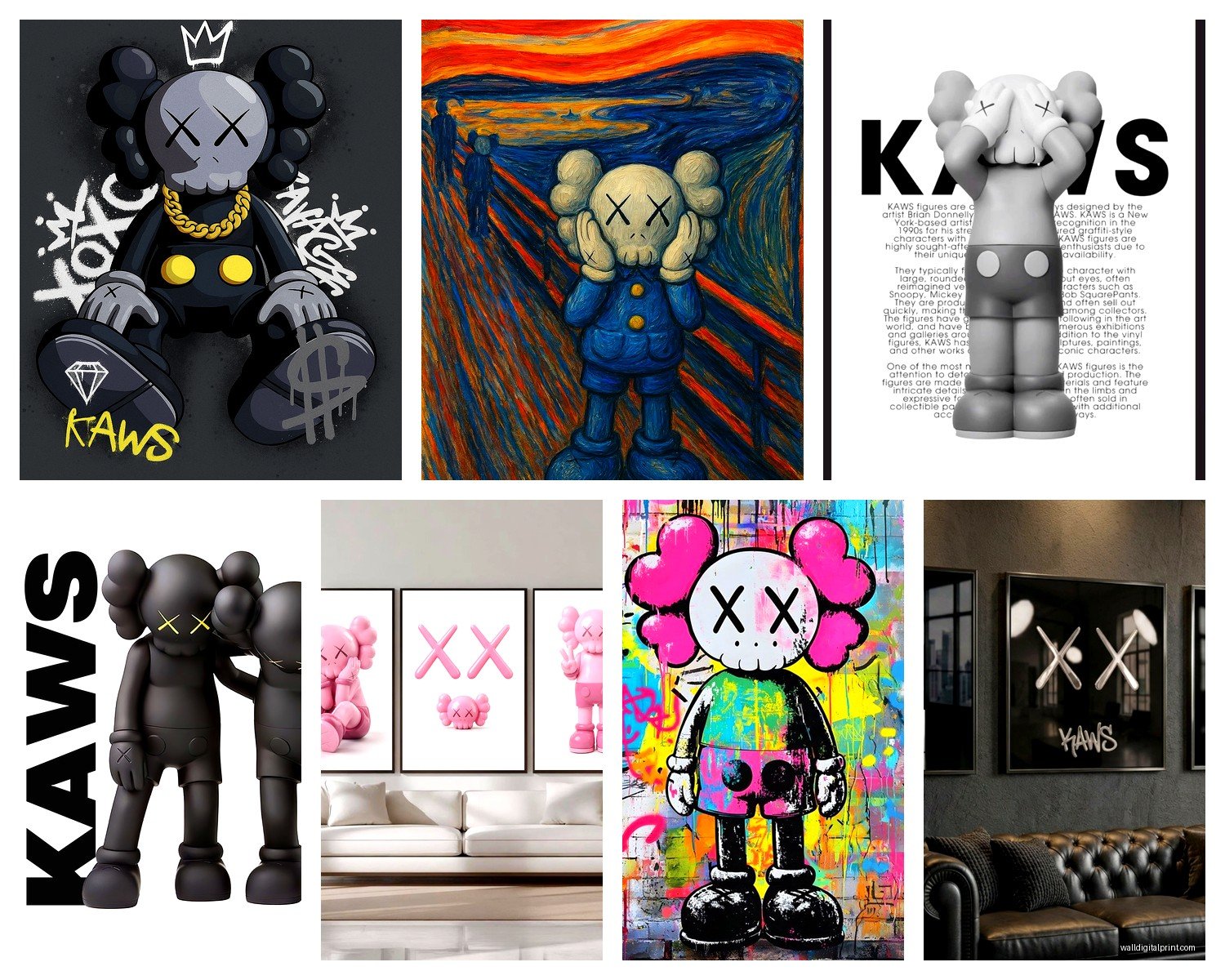
Okay so KAWS wall art isn’t just one thing, which makes it confusing when you’re starting out. You’ve got original paintings that’ll cost you like a house, limited edition prints that are more accessible, and then there’s all these… let’s call them “market variations” that pop up on different sites. The Companion character is what most people recognize – that skull-faced figure with the X’s for eyes. Sometimes it’s solo, sometimes it’s doing the whole dissected thing where you can see the bones and internal structure.
The prints are where I tell most people to start because you’re looking at anywhere from $500 to $15,000 depending on edition size and year. Original screenprints from like 2016 or earlier? Those have gone up insane amounts. I bought “Untitled (Fatal Group)” back in 2020 for around $3,200 and it’s worth probably double that now which is wild.
Print Editions vs Open Market Stuff
Here’s where it gets tricky and I learned this the hard way. Official KAWS prints come with certificates of authenticity, they’re numbered (like 127/500), and they usually release through specific galleries or AllRightsReserved which is his studio. Then there’s this whole secondary market on places like Artsy, 1stDibs, even eBay where you gotta be really careful.
My friend bought what she thought was a legit “Companion” print for $800 and it turned out to be a really good poster. Not even a reproduction, just… a poster. So now I only buy from verified galleries or directly from collectors who can show provenance. Pain in the ass but necessary.
Where to Actually Find Authentic Pieces
DDT Store is KAWS’s own shop but stuff sells out in literal minutes. I’ve set alarms for drops and still missed them because my wifi decided to have a moment. The website crashes, people use bots, it’s a whole thing. But if you can snag something from a primary drop, you’re paying retail which is obviously ideal.
Secondary market places I actually trust:
- Artsy – they vet their galleries pretty well
- 1stDibs – more expensive but usually legit
- Heritage Auctions – for higher end pieces
- Sotheby’s and Christie’s for the stuff that makes me cry when I see the estimates
Oh and another thing – Instagram has become weirdly useful? There are collector accounts that sell pieces and if they have good reputation and references, it’s actually a decent way to find stuff. I bought a “Gone” print from a collector in Tokyo through Instagram DMs and the whole thing felt sketchy but worked out fine. Paid through PayPal goods and services obviously, not like Venmo-ing a stranger $4K.
What to Look for in Terms of Investment Value
Okay so this is gonna sound cynical but some pieces hold value way better than others. The earlier prints from when he was less commercially massive – those are gold. Anything from his OriginalFake era (that was his streetwear brand that ended in 2013) has this cult following.
The “Companion” series variations:
- Original colorways (especially grey and black) tend to be more valuable
- Limited runs under 300 prints are obviously better than 500+
- Collaborations with like Dior or Uniqlo… it’s mixed because some feel too commercial
I personally love the “Blame Game” print but it’s not as investment-strong as some of his older work. Doesn’t matter to me because it looks incredible in my office space and sometimes you just gotta buy what makes you happy when you look at it, not what Sotheby’s might want in 10 years.
Size Actually Matters Here
The larger format prints command higher prices but they’re also harder to display unless you’ve got serious wall space. Most of his prints come in standard sizes – you’ll see a lot of 40×30 inches or similar. I made the mistake of buying a massive piece without measuring my wall first and it literally doesn’t fit anywhere in my apartment except awkwardly above my couch where it blocks this light fixture. Learn from my mistakes, measure your actual space.
Framing and Display Considerations
So you’d think just throw it in a frame and done, right? Wrong. These prints need UV-protective glass or acrylic because the colors can fade, especially the vibrant pinks and blues he uses. I use museum glass which is expensive (like $300-400 for a good frame job) but worth it.
My cat knocked over a framed print once and regular glass shattered everywhere, so now everything’s in acrylic. It’s lighter anyway and doesn’t have that glare issue if you use the premium stuff.
Wait I forgot to mention – some collectors don’t frame at all and keep prints in archival storage. That’s probably smarter for pure investment purposes but what’s the point of owning art you never see? I’m not a storage unit, I actually want to enjoy the stuff.
The Whole Authentication Thing
Every legitimate KAWS print should have a certificate of authenticity. It’s usually a separate card or paper that comes with the print, has the edition number, title, year, and often a stamp or signature from the gallery. Keep this somewhere safe – I have a folder with all mine because without it, resale value tanks.
Some older pieces might not have COAs because that wasn’t standard practice in like 2005, but they should have gallery provenance you can trace. If someone’s selling a “rare early KAWS” with zero paperwork and can’t tell you where it came from, that’s a red flag the size of Texas.
This is gonna sound weird but I actually photograph everything when I buy it – the print, the COA, the packaging, any stamps or markings. Creates a digital trail that’s helped when I’ve had to verify authenticity for insurance purposes.
Spotting Fakes and Reproductions
The print quality is usually the giveaway. Real KAWS screenprints have this texture and depth to them, the colors are super saturated and clean. Fakes often look flat or the registration is off – like the colors don’t line up perfectly.
Also check the paper. He typically uses high-quality art paper with specific weights. If it feels like poster paper or photo paper, something’s wrong. I’ve handled enough of these now that I can kinda tell by touch which probably makes me sound pretentious but whatever, it’s true.
Price Ranges Based on What’s Out There
Okay so as of right now, here’s roughly what you’re looking at:
- Recent prints from primary drops: $400-$1,500
- Secondary market prints from last 5 years: $1,000-$8,000
- Older prints (2010-2015): $5,000-$25,000
- Really early or rare editions: $25,000+
- Original paintings: don’t even ask unless you’ve got six figures minimum
I’ve seen prices fluctuate based on hype cycles too. When he did that Dior collaboration, everything spiked. When he had a major museum show, prices went up. It’s kinda tied to his cultural relevance at any given moment.
Building a Collection vs Buying One Piece
If you’re just starting, honestly pick one piece you genuinely love and start there. I see people trying to build collections too fast and they end up with a bunch of mid-tier stuff instead of one really good piece. My first KAWS was a “Untitled (Fatal Group)” print and I saved for like eight months to buy it. No regrets.
Once you have one, you start understanding his visual language better and what resonates with you. Some people love the colorful pop art vibes, others prefer the more somber monochromatic pieces. I’m drawn to the ones with this weird sadness to them – the Companion figure always looks kinda lonely to me which sounds dramatic but that’s what I see.
Mixing KAWS with Other Art
In my space I’ve got KAWS next to some abstract pieces and vintage photography and it actually works? The key is not making your wall look like a Supreme store exploded. I use KAWS as an anchor piece and build around it with stuff that either complements the colors or contrasts the style.
My living room has a grey Companion print next to this black and white Mapplethorpe photograph and they play off each other in this unexpected way. Both have this graphic quality but completely different contexts.
The Resale Reality
People always ask me if these are good investments and honestly… it depends. The market for street art and contemporary collectibles is strong right now but it’s also speculative. I’ve made money on pieces I’ve sold, but I’ve also held onto stuff that hasn’t appreciated as much as I thought it would.
If you’re buying purely for investment, you gotta be strategic about edition sizes, provenance, condition, and timing. If you’re buying because you love the work, investment potential is just a bonus. I’m somewhere in the middle – I want pieces I enjoy but I’m also not mad if they increase in value.
Storage and Insurance
Oh and another thing nobody tells you – once you start collecting art that’s worth actual money, you need to think about insurance. My renters insurance didn’t cover my collection adequately so I got a separate fine art policy. It’s like $600 a year for $50K in coverage which felt excessive until I actually calculated what I’d spent.
Store unframed prints flat in archival boxes, not rolled. Keep them away from humidity and temperature fluctuations. Basically treat them like they’re precious because they are, even though KAWS came from street art culture and there’s this irony in being so precious about it.
Look, at the end of the day KAWS wall art is one of those things where you can get in at different levels. You don’t need to drop $20K to own something authentic and cool. Start with what you can afford, buy from reputable sources, and actually enjoy the piece instead of just seeing it as an asset. The Companion figure has been staring at me from across the room this entire time I’ve been typing this and it still makes me happy, which is probably the whole point anyway.