Wall Art Guide, Wall Art Tutoriels
Modern Glass Wall Art: Contemporary Transparent Sculpture
Aug
So I’ve been obsessing over glass wall art lately and honestly it’s one of those things where you think “how hard can it be” and then you’re down a rabbit hole at 2am watching installation videos. Let me just dump everything I’ve learned because I literally just helped my sister pick pieces for her new loft and we made some mistakes you can totally avoid.
Understanding What You’re Actually Getting
Okay so first thing – contemporary glass wall art isn’t all the same. There’s fused glass (where they literally melt different colored glass pieces together in a kiln), there’s cast glass (poured into molds), and then there’s sculptural glass that’s hand-blown and mounted. The price differences are WILD. I saw a small fused piece for like $200 and a hand-blown sculpture for $3,000 and honestly they both looked amazing but served completely different purposes.
The transparent ones are tricky because you gotta think about what’s behind them. I made this mistake in my own hallway where I hung this gorgeous clear sculpture but the wall behind was this weird beige and it just looked… muddy? Changed the wall to a deep charcoal gray and suddenly the piece came alive. The light refraction is the whole point with transparent sculptures.
Weight Is Your First Real Problem
Nobody tells you this but glass is HEAVY. Like really heavy. I picked up a piece that was maybe 18 inches across and it was easily 15 pounds. Your standard drywall anchor isn’t gonna cut it. You need to either:
- Find studs and drill directly into them
- Use heavy-duty toggle bolts rated for at least 50 pounds
- Install a french cleat system if it’s a bigger piece
- Get professional mounting if we’re talking anything over 20 pounds
I learned this the hard way when a client’s piece (not installed by me thank god) fell at 3am and shattered. The artist had to remake it and it took four months. So yeah, don’t cheap out on hardware.
Choosing Based on Your Actual Space
This is gonna sound weird but the best glass art I’ve placed was always chosen based on the light situation first, aesthetic second. You need to visit the space at different times of day. Morning light hits different than afternoon light, and if you’ve got western exposure that golden hour situation changes everything.
Natural light makes transparent glass sing. I have this one piece in my dining room that’s basically invisible at night but when morning sun hits it the whole room gets these little rainbow prisms everywhere and my cat goes absolutely insane trying to catch them.
For rooms with only artificial light you want glass that has more color or texture built in. Clear minimalist pieces can look kinda flat under LED bulbs unless you specifically light them, which brings me to…
Lighting Your Glass Art
Oh and another thing – dedicated lighting transforms these pieces. I’m talking about:
- Track lighting positioned at a 30-degree angle
- LED strip lights mounted above or below the piece
- Picture lights (but get the museum-quality ones not the cheap brass ones)
- Backlighting if the piece is mounted away from the wall
The backlit situation is next level but you gotta plan for it during installation. Basically you mount the sculpture on standoffs (little spacers) that hold it 2-3 inches off the wall, then put LED strips behind. The glow effect is incredible but you need an outlet nearby or be ready to hire an electrician.
I did this in a client’s entryway last month and people literally stop and stare when they walk in. Cost like $400 total including the LED setup but it made a $600 art piece look like a $3,000 installation.
Where to Actually Buy This Stuff
Okay so I’ve bought from everywhere at this point. Here’s the real breakdown:
Local art galleries: You’ll pay more but you can see it in person and usually they have relationships with installers. Plus you’re supporting actual artists. I found my favorite piece at a small gallery in Portland when I was visiting my brother.
Online platforms like Artsy or Saatchi: Huge selection, better prices than galleries, but you’re buying based on photos which is sketchy with glass because photos don’t capture the transparency and light play. Always check return policies.
Etsy: This is where I find emerging artists and honestly some of the best deals. But read reviews obsessively and ask for videos of the piece in different lighting. I got burned once by photos that were clearly professionally lit and the actual piece looked totally different in my space.
Direct from artists: Instagram is lowkey the best way to find glass artists now. You can see their process, commission custom work, and usually save the gallery markup. I follow like 30 glass artists and just slide into DMs when I need something specific.
Commission vs Ready-Made
Wait I forgot to mention – commissioning is not as expensive as you think. If you want something specific for a space, especially a larger piece, sometimes commissioning costs the same as buying ready-made because you’re cutting out the middleman.
I commissioned a piece for above my sofa last year. Worked with the artist over email, sent her photos of my space and color palette, she sent sketches, we adjusted, and the final piece was EXACTLY what the room needed. Cost $850 which sounds like a lot but comparable ready-made pieces at that size were $700-900 anyway.
Timeline though – give yourself like 3-6 months. Glass work takes time and kiln schedules get backed up.
Size and Scale Without Screwing It Up
The general rule is your art should take up 2/3 to 3/4 of the available wall space. But with glass I actually go a bit smaller because the light effects make it feel bigger than it is. A 24-inch piece can command a space way better than a 24-inch painting because of the dimension and shadow play.
For over furniture the bottom of the piece should be 6-8 inches above whatever’s below it. I see people hang stuff way too high all the time. Eye level means the center of the piece is at 57-60 inches from the floor, which is standard gallery height.
But honestly? Just tape paper to the wall in the size you’re considering and live with it for a few days. See how it feels. I do this with every placement and it saves so much regret.
Installation Real Talk
If you’re even slightly unsure, hire someone. Glass installers cost like $100-200 for a standard piece and they have insurance. I install smaller pieces myself but anything over 15 pounds or anything expensive I call someone.
For DIY installation you need:
- Stud finder that actually works (I like the Zircon ones)
- Level (get a good one, the cheap ones lie)
- Drill with the right bit for your wall type
- Appropriate anchors or screws
- Painter’s tape for marking
- A helper because doing this alone is asking for disaster
Mark your holes with painter’s tape first, drill pilot holes, then install your mounting hardware. Most glass art comes with its own hanging system – either wire, D-rings, or a mounting plate. Follow the artist’s instructions exactly because they know how their work should be supported.
The Floating Mount Look
This is my favorite mounting style for contemporary glass. You use standoffs which are like little metal spacers that make the piece hover off the wall. Creates amazing shadows and lets light wrap around the edges.
You can get standoff kits on Amazon for like $30-50. They come in different finishes – I usually use brushed nickel or matte black depending on the piece. Installation is basically the same as regular mounting but you’re attaching the standoffs to the wall first, then the art mounts to those.
Maintenance and Cleaning
Okay so funny story – I used Windex on a piece once and it left this weird film. Glass art needs specific care. Most artists recommend just distilled water and a microfiber cloth. For stubborn spots a tiny bit of dish soap works.
Clean every few months or whenever you notice dust building up. Dust really shows on glass especially with backlighting. I have this telescoping duster that I use weekly just to keep major dust off.
Never use paper towels – they scratch. Never use anything abrasive. And be gentle around edges because that’s where chips happen.
Mixing Glass Art with Other Pieces
You can totally create a gallery wall with glass art but it takes planning. I usually do one glass piece as the focal point with other media around it. The transparency creates visual breathing room so you can cluster things closer than you normally would.
Works great with:
- Black and white photography (the contrast is chef’s kiss)
- Metal sculptures
- Minimalist prints
- Mirrors (but not right next to each other, that’s too much reflection)
I did a whole wall in my office with a central glass piece surrounded by vintage botanical prints and it’s probably my favorite thing in my house. The glass catches light and the prints provide context and color.
Color Theory for Transparent Art
If your glass has color you gotta think about how it plays with your wall color and the room’s palette. Blue glass on a blue wall disappears. Blue glass on a warm cream wall pops. Amber or orange glass looks incredible against gray or navy.
Clear glass is the most versatile but also the most dependent on what’s behind it. I keep coming back to this but wall color MATTERS so much with transparent sculpture.
Styles You’ll See Everywhere Right Now
The market is kinda saturated with certain looks so here’s what’s trending:
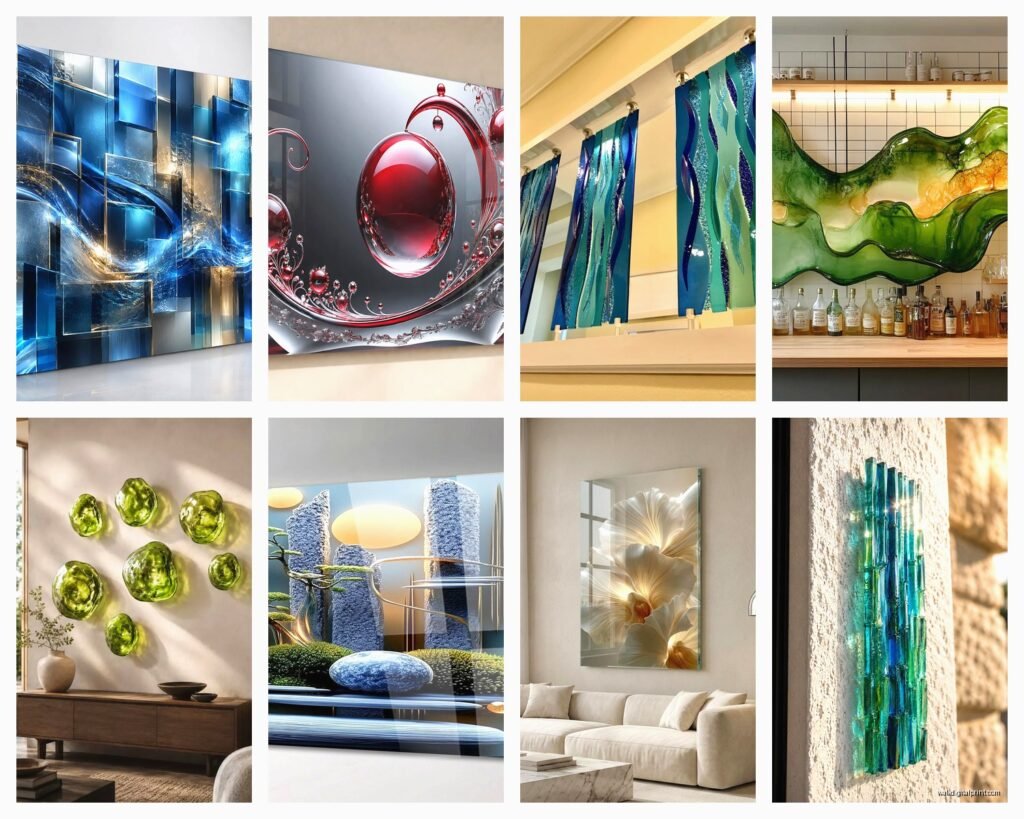
Organic wave forms: Those flowing, ocean-inspired pieces. Beautiful but very of-the-moment so might feel dated in five years.
Geometric abstract: Sharp angles, clean lines, very architectural. More timeless in my opinion.
Botanical: Glass flowers, leaves, nature forms. Can go either traditional or contemporary depending on execution.
Minimalist monochrome: Single color, simple form. Super versatile, works in almost any space.
I personally lean toward geometric and minimalist because I like stuff that’ll still feel current in ten years. But I have clients who go full organic and it looks amazing in the right space.
Budget Real Talk
You can find small fused glass pieces for $150-300. Medium sculptural work runs $500-1500. Large statement pieces or work from established artists starts at $2000 and goes up to like… infinity basically.
The sweet spot I’ve found is $600-900 for something that’s quality, interesting, and substantial enough to actually make an impact. That’s where you find emerging artists doing really cool work before they blow up.
And honestly? One great glass piece beats five mediocre ones. Save up for something you actually love rather than filling space with whatever’s affordable right now.
Wait I should mention – check out university art programs and their student sales. I’ve found INCREDIBLE work from graduate students for like a third of what established artists charge. The quality is there, they just don’t have the name recognition yet.
Special Considerations for Different Rooms
Bathrooms: Make sure it’s properly sealed glass. Moisture can get into unsealed edges and create problems. Also the humidity affects how light refracts which can be cool or weird depending on the piece.
Kitchens: Keep it away from the stove area. Grease and glass art don’t mix. I learned this from a client who had to have a piece professionally cleaned after a year of cooking and it cost almost as much as the art.
Bedrooms: Think about how light hits it in the morning. You want something calming not something that’s gonna blast rainbow prisms at your face when you’re trying to sleep in.
Offices: This is where glass art really works because it adds visual interest without being distracting. The transparency keeps things feeling open which is good for focus.
Okay I think that’s everything swimming around in my brain right now. The main thing is just don’t overthink it too much but also definitely think about the weight and mounting situation because that’s where things actually go wrong. Everything else is just aesthetic preference and you’ll figure out what works for your space once you start looking at actual pieces.