Wall Art Guide, Wall Art Tutoriels
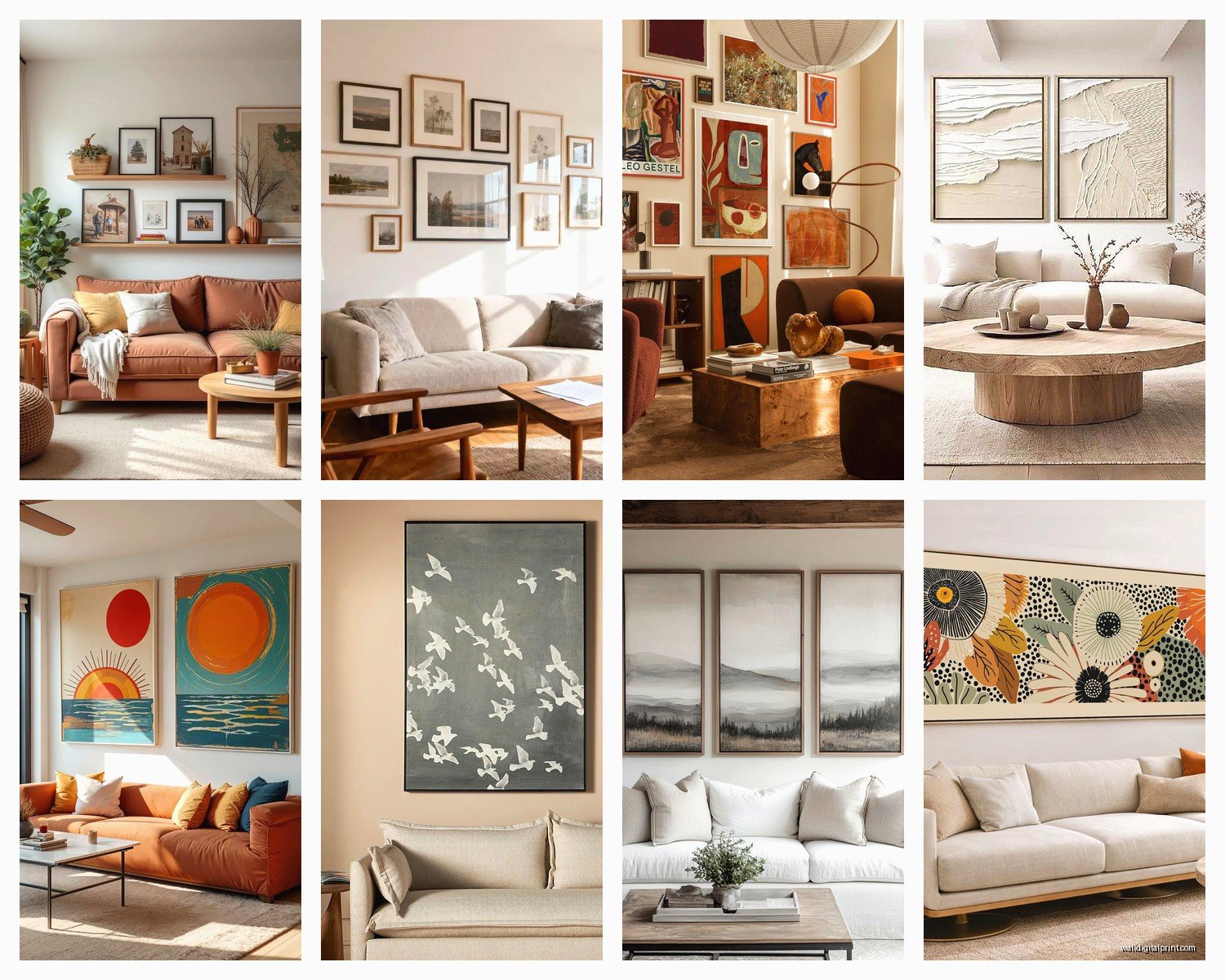
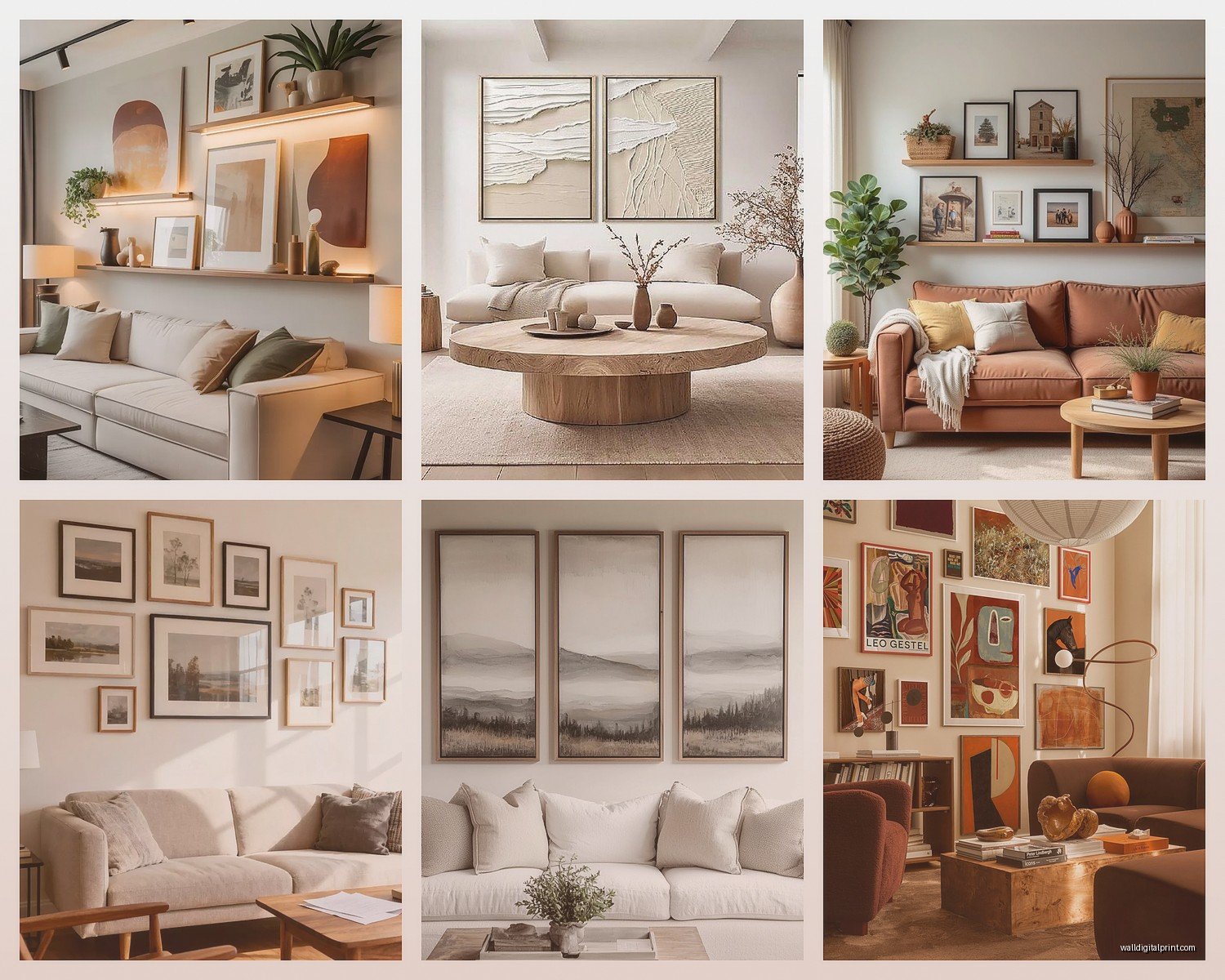
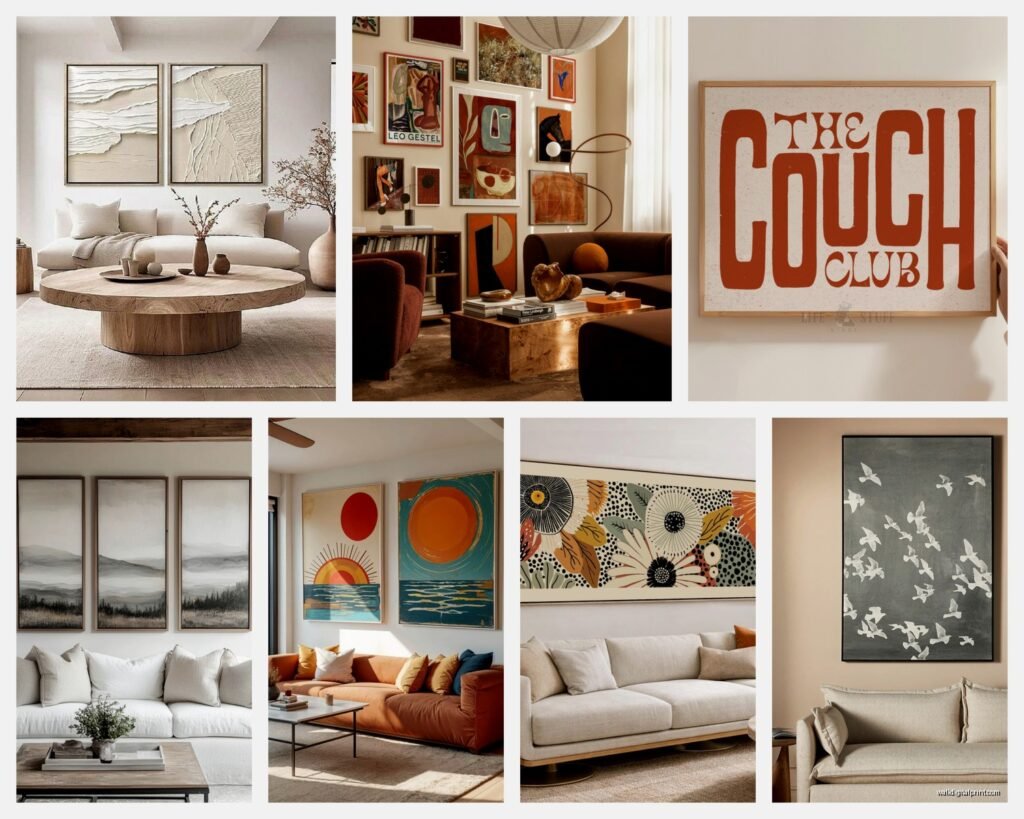
Sofa Wall Art: Above Couch Placement Guide
Jun
So I was literally reorganizing my gallery wall last night while watching The White Lotus and realized I’ve hung probably like 200 pieces above sofas at this point. Let me dump everything I know about this because it’s weirdly specific but also everyone gets it wrong.
The Basic Height Thing Everyone Messes Up
Okay so the rule is 6-12 inches above your sofa back. But here’s what actually matters – you want the art to feel connected to the sofa, not floating up near the ceiling like it’s trying to escape. I usually do 8 inches and call it a day. Measure from the top of your couch back to the bottom of your frame.
The thing is, if you have a really low-slung modern sofa, you might need to go closer to 6 inches or it looks disconnected. Higher backed sofas can handle that 10-12 inch gap. I had this client with one of those massive tufted Chesterfields and we did 10 inches and it still felt tight.
Width is Where People Really Screw Up
Your art should be about two-thirds to three-quarters the width of your sofa. Not the wall – the sofa. I see people hang these tiny 16×20 frames above an 84-inch sectional and it’s just… sad. Like putting a regular-sized hat on someone with a really big head, you know?
If your sofa is 90 inches wide, you’re looking at art that’s roughly 60-68 inches across. That can be one large piece or a gallery wall situation that adds up to those dimensions.
Wait I forgot to mention – if you have a sectional, only measure the longest straight section. Don’t try to center art over the entire L-shape because that gets weird geometrically.
Single Large Piece vs Gallery Wall
This is gonna sound weird but I actually think single large pieces are easier. One big frame, one nail situation, done. You want it centered over the sofa – measure the sofa width, find the center point, mark it on the wall, then measure your frame width and center that over your mark.
Gallery walls are where my perfectionist tendencies go to die honestly. But they look amazing when you get them right. The trick is treating the entire arrangement as one single piece. So all your frames together should follow that two-thirds width rule.
My Gallery Wall Method That Actually Works
I trace all my frames on kraft paper or newspaper. Cut them out exact size. Then I tape them to the wall in different arrangements until something clicks. My cat destroyed my paper templates once and I had to start over, so maybe shut your pets out of the room while you do this.
Start with your largest piece first – that’s your anchor. Usually I put the biggest frame slightly off-center and build around it. Keep consistent spacing between frames, like 2-3 inches. Inconsistent gaps make it look like you hung things randomly over five years.
Oh and another thing – try to keep the overall shape horizontal. Vertical arrangements above sofas feel off because the sofa is such a horizontal element. You’re echoing the furniture’s lines.
What Size Frame For What Size Sofa
Let me break this down because I reference this constantly:
- Loveseat (58-64 inches): One 40×30 piece or two 20×24 frames side by side
- Standard sofa (76-84 inches): One 60×40 piece, or a gallery wall spanning about 55-60 inches
- Standard sectional (90-100 inches): One oversized 72×48 piece or larger gallery arrangement
- Extra long sofa (100+ inches): You’re looking at diptychs, triptychs, or extensive gallery walls. Single pieces need to be like 80+ inches
These aren’t hard rules but they’re my starting point. I’ve definitely gone smaller when the art itself demanded it – like this incredible vintage map I found that was only 36 inches but the sofa was 80. We flanked it with two narrow vertical prints and it worked.
The Actual Hanging Process
Okay so you’ve got your art, you know where it goes, now you gotta actually hang it. Get a laser level if you’re doing multiple pieces – I resisted this for years and used a regular level like some kind of pioneer woman, but laser levels changed my life. They’re like $25.
For single heavy frames, use two D-rings and hang it on two hooks. It’s more stable and you can adjust level more easily. One center hook works for lighter stuff but anything over 20 pounds needs two points of contact.
The Math Part Nobody Likes
Find your center point on the wall. Let’s say your sofa is 84 inches and centered on a 144-inch wall. The sofa edges are 30 inches from each wall edge. Mark your wall center – that’s 72 inches from either side.
Your frame is 60 inches wide. Half of that is 30 inches. Measure 30 inches left and right from your center mark – that’s where your frame edges land. If you’re hanging on D-rings, measure the distance between the rings on your frame, find center between them, and that center point goes on your wall center mark.
For height: measure your sofa back height from the floor. Let’s say it’s 32 inches. Add your 8-inch gap. Bottom of your frame should be at 40 inches from the floor. Measure your frame height, add it to 40 inches, and that’s where the top of your frame sits.
But here’s the thing – you’re not measuring to the top of the frame, you’re measuring to where the nail goes. So flip your frame over, measure from the top edge down to where the wire or D-ring sits when pulled taut. Subtract that number from your “top of frame” measurement. THAT’S where your nail goes.
I know that’s confusing. I still sometimes hang things twice because I forget this step.
Style Stuff That Actually Matters
Okay so funny story, I once hung this beautiful abstract piece above a really ornate traditional sofa and it looked like they were fighting. Your art doesn’t have to match your sofa style exactly, but they shouldn’t be actively contradicting each other.
Modern minimal sofa = works with abstract art, black and white photography, line drawings, geometric stuff
Traditional sofa = landscapes, classic photography, ornate frames, vintage prints
Mid-century sofa = literally anything honestly, that style is so flexible. Abstract, photography, vintage travel posters, botanical prints
The frame matters more than people think. A baroque gold frame makes everything traditional. A simple black or natural wood frame keeps things contemporary. I switched just the frames on some art once and it completely changed the room vibe.
Color Coordination Without Being Matchy-Matchy
Pull one or two colors from your art into your pillows or throw blankets. Not all the colors – that’s too much. Just one accent color that repeats. Or go completely neutral with the art and let your sofa and pillows be colorful. Both approaches work.
My living room has a gray sofa with this massive abstract piece that’s mostly cream and rust. I have rust pillows. That’s it. It’s enough.
Lighting Because Nobody Thinks About This
If you hang art and it disappears into shadow, you messed up. You need either natural light hitting it during the day or you need picture lights or track lighting. I added two small picture lights to a client’s gallery wall and it went from “fine I guess” to “oh WOW” immediately.
Battery-operated picture lights exist now and they’re shockingly good. You don’t need to hire an electrician anymore. Just stick them on, they last like 6 months on batteries, done.
Common Mistakes I See Constantly
Hanging art too high. If you’re gonna err, err on the side of lower. Too high looks like it’s levitating away from your furniture.
Choosing art that’s too small. This is the number one issue. People are scared of big art but you need it above a sofa. Go bigger than feels comfortable. You’ll adjust to it in like three days.
Not using a level and just eyeballing it. You cannot eyeball it. You think you can, you cannot. Your eye lies to you. Use the level.
Putting glass-covered art across from windows where it’ll create glare. Move it or use non-glare glass. Regular glass is a mirror in the wrong light.
The Rental Problem
If you can’t put holes in your walls, get a large-scale leaning piece. Like a 40×60 canvas that just leans against the wall on top of a console table behind your sofa. Or use those Command picture hanging strips – the heavy duty ones actually hold up to 16 pounds if you use enough of them.
I’ve also seen people use tension rods near the ceiling with art hanging from them on fishing line. It looks intentional if you commit to it.
Budget Real Talk
You don’t need expensive art. You need the right size art. I’ve used Etsy prints, Society6, thrifted frames with new art, even blown up personal photos. A $30 print in a $50 frame at the right size looks better than a $500 piece that’s too small.
Frame quality matters more than art price honestly. A cheap poster in a nice frame reads as intentional. A nice print in a cheap frame reads as temporary.
My Actual Sources
- Etsy for downloadable prints I get printed at FedEx
- Framebridge for custom framing that’s not insane pricing
- West Elm and CB2 for ready-made large pieces during sales
- Estate sales for vintage frames I put new art in
- Minted for photography prints
The Framebridge thing changed my approach because I can frame weird-sized vintage stuff affordably now. Their online tool is actually accurate too.
Testing Before You Commit
This is gonna sound extra but I sometimes project images onto the wall with a digital projector to see how a piece will look before I buy it. Or I just tape up a piece of paper the right size and live with it for a few days. If the blank rectangle annoys me, I know the spot is wrong.
You can also use painter’s tape to outline where your frame will go. Step back, look at it from your usual sitting position on the sofa, see if the proportions feel right. Adjust before you make holes.
Oh and take pictures with your phone from where you normally sit. The camera sees different than your eye and sometimes reveals balance issues you miss in person.
Switching Things Out
I change my art seasonally sometimes and it’s easier if you plan for it. Use the same size frames so the nail placement stays the same. Or get a picture rail system installed – they make modern minimal ones now that don’t look Victorian.
Honestly though, I’m lazy about switching art so I usually just pick something I can live with year-round. Abstract stuff doesn’t feel seasonal. Landscapes can depending on what they show.
The main thing is just committing to the right size and height. Everything else is personal preference, but those two measurements will make or break the whole situation. Too small and too high is the default mistake – just do the opposite and you’re already ahead of most people.