Wall Art Guide, Wall Art Tutoriels
Wall Art Large Living Room: Oversized Main Space Pieces
Sep
So I was literally just helping my sister pick out this massive piece for her living room last week and honestly, the whole oversized wall art thing is trickier than people think. Like, everyone sees those Instagram photos with the giant abstract painting above the sofa and thinks “yeah I want that” but then you get into the actual measurements and suddenly it’s like… wait, how big is too big?
Okay first thing, and I cannot stress this enough – measure twice, order once. I learned this the hard way when I bought this gorgeous 6-foot canvas for a client and it literally overwhelmed their entire wall. We’re talking it made the room feel smaller, not bigger, which is the opposite of what you want. The general rule I follow now is that your art should take up about 60-75% of the furniture width below it. So if you’ve got an 8-foot sofa, you’re looking at somewhere between 5-6 feet of art width. But honestly, I sometimes go a bit smaller if the piece itself is really bold or has intense colors.
The height thing messes people up too. Center point should be at eye level, which is roughly 57-60 inches from the floor. But here’s where it gets weird – if you’re hanging above a sofa, you want the bottom of the frame to sit about 6-8 inches above the back of the couch. Not the seat cushions, the actual back. I once hung a piece too high in my own living room and my husband kept saying it looked like it was floating away. He wasn’t wrong.
What Actually Counts as “Oversized”
People throw around the term oversized but like, what does that mean really? In my world, we’re talking anything over 40 inches in any direction. Once you hit that 4-foot mark, you’re in statement territory. The pieces I recommend most for large living rooms are usually in the 48×36 inch range minimum, going up to like 72×48 or even bigger if you’ve got the wall space and the budget.
Canvas prints are gonna be your most affordable option. You can find decent ones for $200-500 depending on size. I’ve used CanvasPop and iCanvas for clients with good results. The quality isn’t gallery-level but for a living room? Totally fine. Just make sure you’re getting a 1.5-inch depth minimum on the stretcher bars so it doesn’t look cheap and flat against the wall.
Oh and another thing – framed prints under acrylic or glass get SO expensive when you go large. I’m talking $800+ easily once you factor in custom framing. But they do look more polished and professional. There’s this framing place I use sometimes that does UV-protective acrylic and it’s worth it if you’re putting the art across from windows. Sun damage is real and I’ve seen beautiful prints just fade into nothing over a couple years.
Style Options That Actually Work
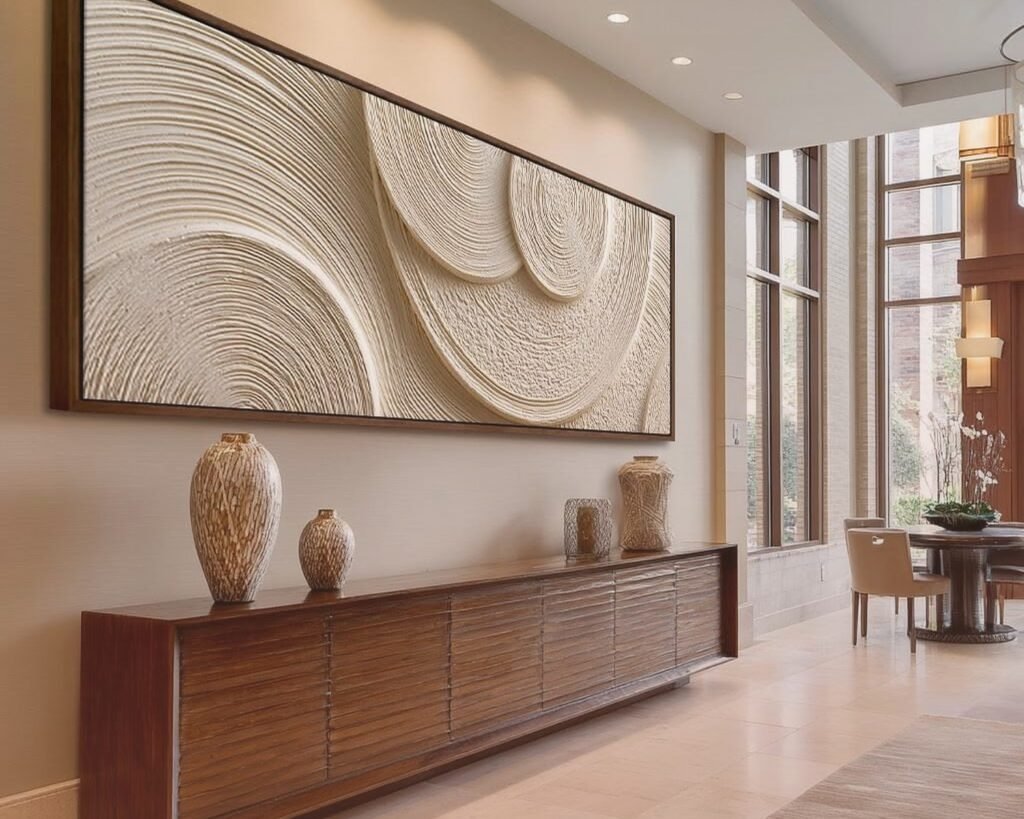
Abstract is obviously the easiest route because it goes with everything and doesn’t demand too much attention. Those neutral beige and cream abstracts are everywhere right now – West Elm, CB2, Anthropologie. They’re safe, maybe too safe? I did a whole condo last month in those tones and it looked great but also kinda… forgettable.
If you want something with more personality, I’ve been really into oversized photography lately. Black and white landscapes, architectural shots, even those aerial beach photos. There’s an artist on Etsy – I think the shop is called PhotographyByAleah or something – who does these massive desert prints that are stunning. Way more interesting than another abstract honestly.
Botanical prints scaled up huge are having a moment too. Like a single palm leaf or monstera that’s 5 feet tall. It’s dramatic without being aggressive. Works really well in modern organic spaces or even traditional rooms if you frame it right.
Wait I forgot to mention – diptychs and triptychs (that’s two or three panels) can be easier to manage than one massive piece. You get the same visual impact but they’re easier to hang, easier to transport, and honestly easier to afford because you can buy them over time. I did this in my own place with three 30×40 panels and it reads as one large installation but I didn’t have to drop $600 at once.
The Actual Hanging Process
This is where people panic but it’s really not that bad. For anything over 30 pounds, you need to hit studs. Period. Those adhesive strips or drywall anchors aren’t gonna cut it and I’ve seen too many expensive pieces on the floor because someone thought they’d be fine.
Get yourself a stud finder – the Zircon ones are like $25 at Home Depot and they work fine. Mark your studs with painter’s tape. Then use D-rings on the back of your frame and picture hanging wire rated for double the weight of your piece. Paranoid? Maybe. But I haven’t had anything fall yet so.
For really heavy pieces, I actually call in my handyman. It’s worth the $75 to have someone with a level and experience do it right. My cat knocked over a picture once while I was trying to measure alone and I just… I can’t deal with that stress anymore.
Tools You Actually Need
- Stud finder (obviously)
- 6-foot level – the small ones are useless for large art
- Drill with the right bits for your wall type
- Picture hanging kit with heavy-duty hooks
- Painter’s tape for marking
- Pencil
- Measuring tape
- Someone to help you hold it up while you figure out placement
That last one isn’t a tool but seriously, don’t try this alone.
Where to Actually Buy Large Wall Art
Okay so I’ve tested like… a lot of sources. Pottery Barn and West Elm have good options but you’re paying for the name. Their sale section though? That’s where it’s at. I’ve gotten 60×40 pieces for under $300 during their semi-annual sales.
Etsy is honestly my secret weapon. You can find independent artists doing custom sizes and the quality is usually better than mass-produced stuff. Plus you’re supporting actual artists which feels good. Search terms like “large abstract canvas” or “oversized wall art” and filter by size. Takes some digging but worth it.
Society6 and Minted do large format prints and you can choose your framing options. The framing gets pricey but their print quality is solid. I used Society6 for a client’s beach house and three years later it still looks perfect.
This is gonna sound weird but, HomeGoods and TJ Maxx sometimes have gorgeous oversized pieces for like $150-250. It’s totally hit or miss – I’ve gone in and found nothing good for months, then walked in on a random Tuesday and scored a 5-foot abstract that looked like it should cost $800. You gotta be patient and check regularly.
For the high-end route, Saatchi Art and Artsy connect you with actual galleries and artists. Prices start around $1000 and go up from there, but you’re getting original work or limited editions. I have a client who bought a 6-foot painting from an emerging artist through Saatchi and it’s appreciated in value, so there’s that.
Common Mistakes I See All The Time
Going too small is honestly the biggest one. People get nervous about oversized art and then buy something that’s just… medium-sized. And it looks sad and lost on this big wall. If you’re questioning whether to size up or down, size up. You can always balance it with other elements.
Hanging it too high is the other major issue. I see this in probably 60% of homes I walk into. Art floating near the ceiling like it’s trying to escape. Remember that 57-60 inch center line from earlier. Your eye should naturally land on the middle of the piece when you’re standing, not looking up at it.
Oh and matching your art too perfectly to your decor. This sounds counterintuitive but art should complement your space, not match it exactly. If your sofa is gray and your walls are gray and then you get gray artwork… it’s just a gray void. Pull in accent colors or go totally different to create contrast and interest.
Forgetting about the room’s architecture is another thing. If you have really high ceilings, one horizontal piece might look squat. Consider going vertical or doing a gallery wall with a large piece as the anchor. I did a two-story living room last year where we used a 7-foot vertical canvas and it was perfect for drawing the eye up.
Making It Work With Your Actual Life
Like, theory is great but you’re living in this space. If you have kids or pets, maybe don’t put that $2000 original oil painting within reach. I learned this when a client’s dog wagged his tail right into a corner of a canvas. We fixed it but still.
Lighting matters more than people think. If you’re investing in a large piece, consider adding picture lights or positioning floor lamps to highlight it at night. Those LED picture lights that run on batteries are actually pretty good now – I installed some from Amazon for like $40 and they make such a difference.
Also think about your TV situation. If you’re one of those people who wants art above the TV, the TV needs to be at proper viewing height first (which is lower than people think), and then the art goes above that. Or honestly? Put the art somewhere else and let the TV be on its own wall. Your neck will thank you.
Quick Size Reference Guide
- Small living room (under 200 sq ft): 40×30 to 48×36 inches
- Medium living room (200-350 sq ft): 48×36 to 60×40 inches
- Large living room (350+ sq ft): 60×40 to 72×48+ inches
But honestly these are just starting points. I’ve put massive pieces in small rooms and it worked because the room had high ceilings and minimal furniture. Trust your eye.
The whole process doesn’t have to be stressful. I literally spent an hour last night watching The Bear and scrolling through Etsy looking at oversized botanicals because it’s actually fun when you’re not overthinking it. Find something you genuinely love, make sure it fits your measurements, hang it properly, and you’re done. If you hate it after a month, you can always change it out. That’s the thing about wall art – it’s not permanent even though it feels like a big decision.
Just measure your wall, measure your sofa, and don’t buy anything that costs more than you’re comfortable with. There’s good art at every price point and the most important thing is that you actually like looking at it every day.