Wall Art Guide, Wall Art Tutoriels
Evil Eye Wall Art: Protection Talisman Turkish Nazar
Jul
So I’ve been obsessing over evil eye wall art lately and honestly it started because this client wanted something “protective but chic” for her entryway and I fell down this whole rabbit hole of Turkish nazar symbolism and now half my apartment has these blue eyes staring at people.
The thing about evil eye pieces is they’re not all created equal. Like you can grab one from a tourist shop or you can get something that’s actually handcrafted and the difference is massive. I learned this the hard way when I ordered what looked gorgeous online and it showed up looking like a cheap plastic keychain someone glued to a canvas.
What You’re Actually Looking At
The Turkish nazar is basically this ancient talisman that’s supposed to deflect negative energy and jealous glances. The traditional ones are concentric circles in blue, white, sometimes black, and they’ve been around for literally thousands of years. Turkey, Greece, Middle East—everyone’s got their version but the Turkish ones have this specific cobalt blue that’s just *chef’s kiss*.
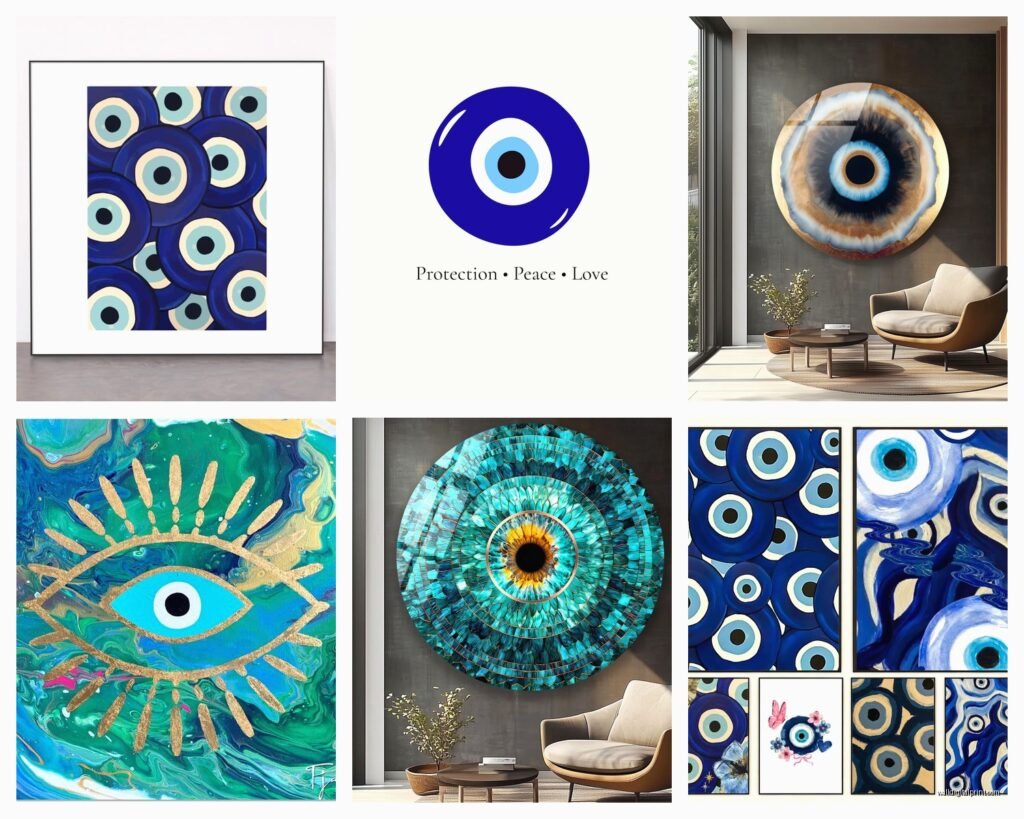
When you’re shopping for wall art versions you’re gonna see everything from hand-painted ceramic plates to modern minimalist prints to elaborate mosaic pieces. I’ve tested probably 20 different styles at this point because my job lets me justify these purchases as “research” and my partner just rolls his eyes at our credit card statements.
The Ceramic Plate Situation
Okay so the ceramic plates are probably the most traditional route. These are usually hand-painted in Turkey or Greece and they come in sizes ranging from like 4 inches to massive 16-inch statement pieces. I have a set of three different sizes clustered on my living room wall and people always ask about them.
What to look for: the glaze should be smooth and even, the colors should have depth not just flat paint, and there should be some weight to it. If it feels light as a feather it’s probably mass-produced garbage. The good ones have this slight irregularity in the circles that shows actual human hands painted them.
I got mine from this Etsy seller in Cappadocia and they were like $45 each for the medium size which felt steep but they’re SOLID. They came wrapped in approximately seven miles of bubble wrap which was annoying to unwrap but at least they arrived intact.
Hanging tip that nobody tells you: these plates need proper plate hangers, not just command strips. I tried command strips first because I’m lazy and the medium one crashed down at 3am and scared my cat so badly she didn’t come out from under the bed for six hours. Get the disc adhesive hangers or the wire ones that grip the edges.
Modern Canvas and Print Versions
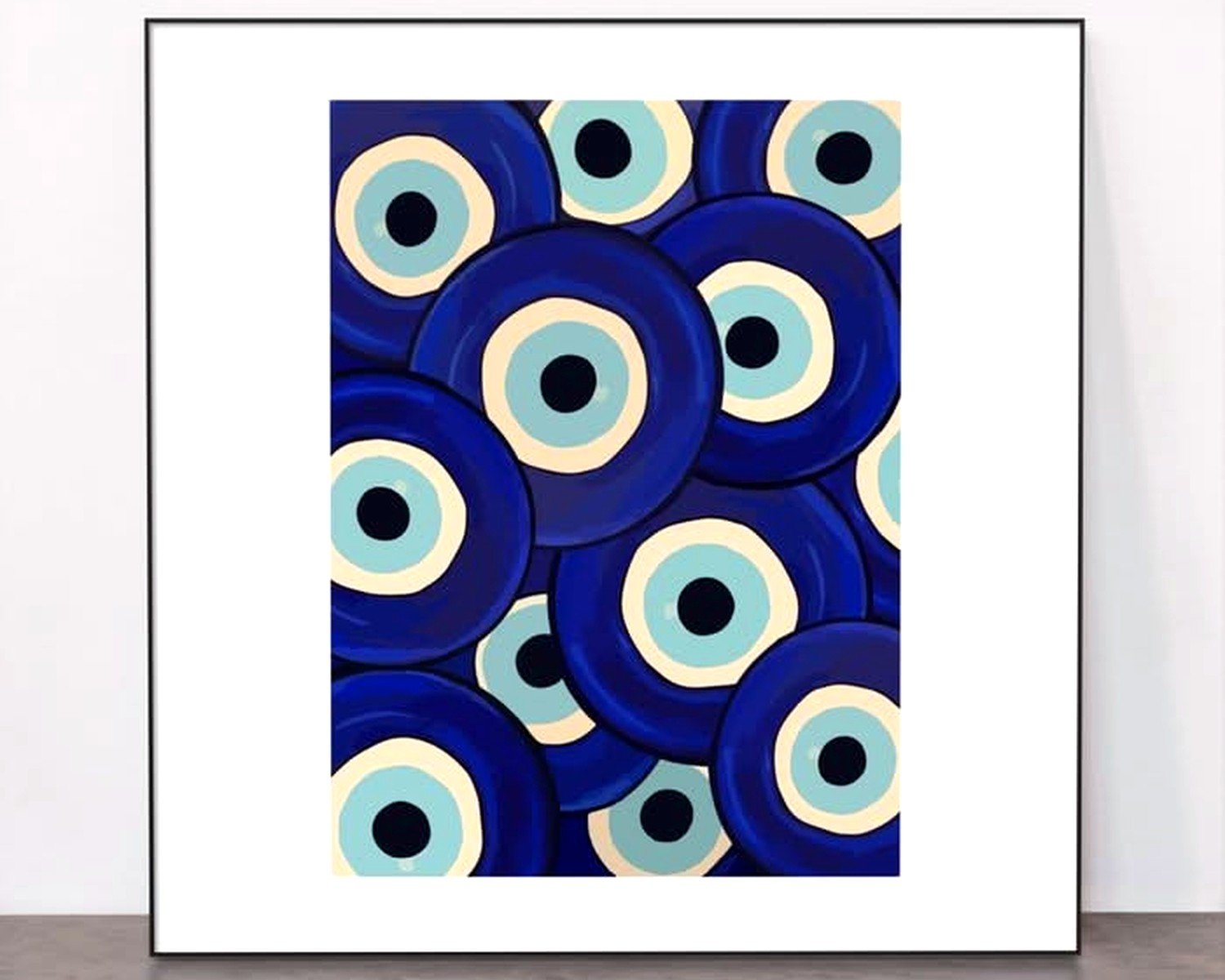
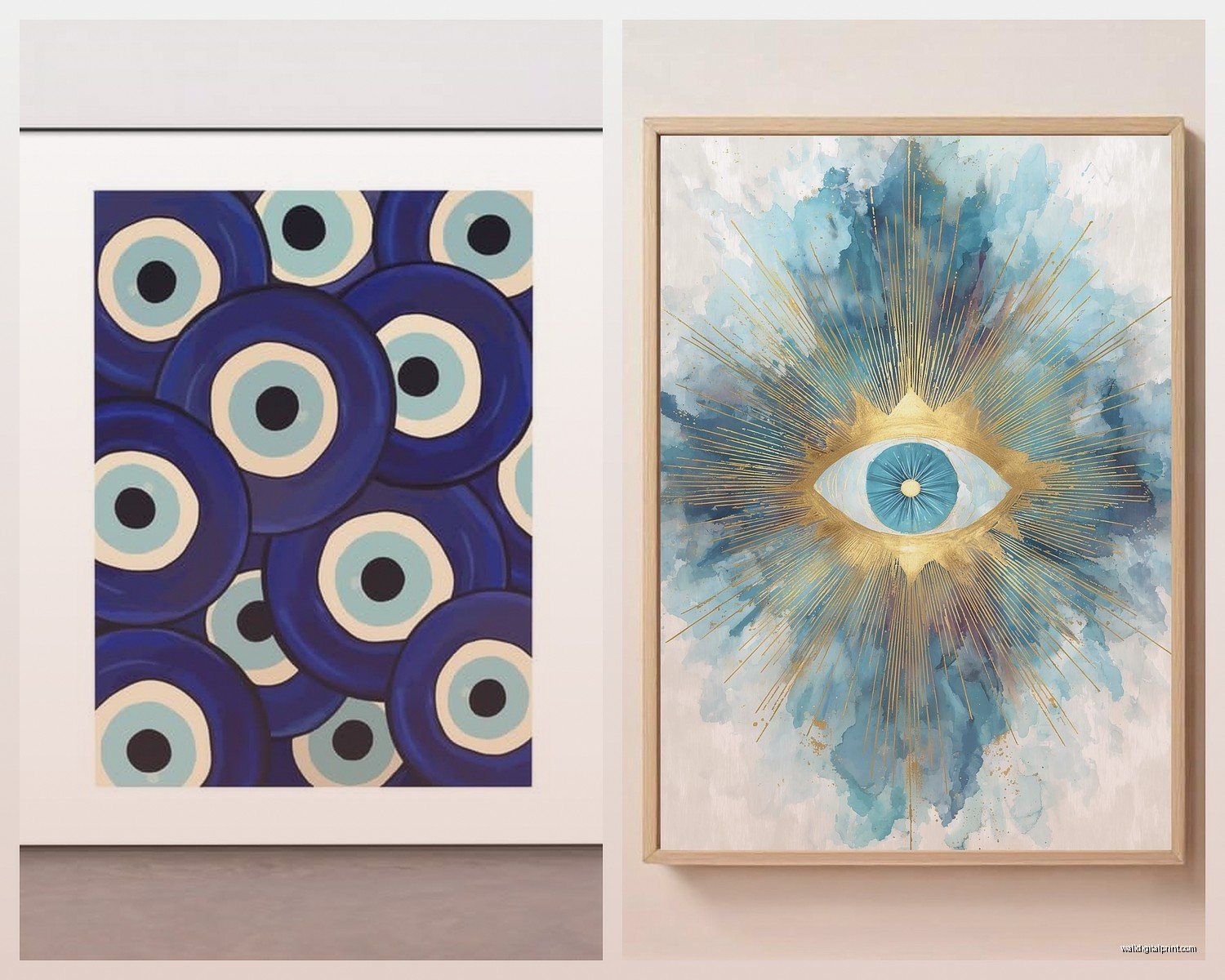
If you want something less traditional there’s a whole world of contemporary evil eye art. Abstract versions, watercolor styles, gold foil accents, all that. I curated a whole series for a boutique hotel last year and we mixed traditional nazar with modern geometric interpretations.
The canvas prints are easier to hang obviously and they come in standard frame sizes which is convenient. But here’s what I noticed—a lot of them look amazing in product photos and then arrive looking washed out or the colors are off. Always always always read reviews with photos from actual buyers.
I found this one artist on Society6 who does these incredible indigo and gold leaf evil eye pieces and the quality was actually impressive for a print-on-demand service. The canvas texture was substantial and the colors were vibrant. It was like $89 for a 24×36 which isn’t cheap but compared to original art it’s reasonable.
The Resin and 3D Options
Oh and another thing—resin evil eyes are having a moment right now. These are usually circular pieces made from layers of colored resin with the eye design embedded in them. They catch light in this really cool way and they’re more durable than ceramic.
I have one in my bathroom that’s like 8 inches across and it’s mounted on a little wooden stand so it sits out from the wall about an inch. The depth effect is really striking, especially with the window light hitting it in the morning. That one was $72 from a maker in California who does custom colors.
The downside is they’re heavier than they look so you definitely need a sturdy anchor. I used a toggle bolt in drywall and it’s been solid for eight months now. Regular nails won’t cut it for anything bigger than maybe 6 inches.
Size and Placement Strategy
This is where people mess up constantly. They either go too small and it looks like an afterthought or they get something massive that overwhelms the space.
For an entryway or above a console table you want something substantial—at least 12 inches across, or a grouping of smaller pieces. The idea is it should catch attention as people enter because traditionally you’re supposed to place these near doorways to protect against negative energy coming in.
I did a gallery wall in my hallway with seven different evil eye pieces ranging from 4 to 10 inches and arranged them asymmetrically. Started with the largest piece slightly off-center and built around it. Took me three tries and approximately 40 nail holes to get it right but now it looks intentional and collected.
Living rooms can handle bigger statement pieces. I’ve seen 20+ inch ceramic plates that work beautifully as focal points above sofas. Just make sure you’ve got the wall space for it to breathe—you need at least 6 inches of clear space around a large piece or it looks cramped.
Bedrooms are tricky because you don’t want too many eyes staring at you while you sleep which sounds paranoid but it’s a real thing. I keep mine to one medium piece on the wall opposite the bed. My friend has one directly above her headboard and she swears it gives her weird dreams but that might just be her being dramatic.
Color Variations Beyond Blue
Wait I forgot to mention—you don’t have to stick with traditional blue. I’ve been seeing gorgeous versions in emerald green, deep purple, even all-white minimalist interpretations. The symbolism is more about the eye shape than the specific colors though blue is considered most protective traditionally.
I used a black and gold version for a client’s modern industrial loft and it was perfect. Kept the protective symbolism but fit the aesthetic way better than bright blue would have. It was this metal cutout design with gold leaf detail, really sophisticated.
There’s also hamsa hand versions that incorporate the evil eye in the palm which gives you more coverage if you believe in that sort of thing. I’m not gonna say whether I believe or not but I will say my apartment has felt weirdly more calm since I added these pieces and maybe that’s placebo but I’m not complaining.
Where to Actually Buy Quality Pieces
Etsy is honestly your best bet for authentic handmade stuff. Search for Turkish nazar or Greek mati and filter by location if you want actual imports. I’ve had good luck with sellers in Istanbul, Athens, and weirdly enough some amazing artisans in New Mexico who studied the craft traditionally.
Society6 and Minted for modern print versions—they run sales constantly so wait for 20% off at least. The quality control is generally solid because artists upload high-res files.
Local Middle Eastern or Mediterranean import shops if you have them nearby. I found an incredible 14-inch ceramic piece at a Turkish grocery store of all places for $30. It was hidden behind the baklava display and the owner said it was from his grandmother’s village. Could be a sales pitch but it’s gorgeous regardless.
HomeGoods and TJ Maxx sometimes have evil eye decor but it’s hit or miss. I’ve found decent small pieces there for like $12.99 but also a lot of cheap looking stuff. You gotta dig.
This is gonna sound weird but estate sales and antique shops sometimes have vintage nazar pieces that are absolutely stunning. I got a 1970s ceramic one at an estate sale in Portland for $8 and it’s now worth probably $150+ based on what I see similar pieces going for online.
The Framing Question
If you get a print version you’re gonna need to decide on framing. I usually go with simple black or natural wood frames for evil eye art because you want the piece itself to be the focus. White frames can work if you’re going for a coastal Mediterranean vibe.
Custom framing is expensive though—like $100+ for a decent size. I’ve been using Framebridge for some client projects and their quality is solid but it’s still pricey. For personal stuff I just buy frames from Michael’s with a 50% off coupon and swap out the generic art they come with.
Floating frames work really well for canvas pieces because they give it a gallery feel. Target actually has affordable floating frame options now in their Threshold line that don’t look cheap.
Styling Around Your Evil Eye Piece
Okay so you’ve got your nazar art and now you need to make it look intentional not random. I usually pair them with natural textures—woven baskets, ceramic vases, dried pampas grass. The mix of organic elements with the symbolic talisman creates this collected global aesthetic.
Metallic accents work great too. Gold or brass candlesticks, copper planters, that sort of thing. The warm metals complement the cool blues of traditional nazars.
If you’re doing a gallery wall situation mix your evil eye pieces with other Mediterranean or Middle Eastern inspired art—olive branches, abstract geometric patterns, vintage travel posters. I did one wall that mixed three different evil eye pieces with botanical prints and old maps of Turkey and it looked like I’d been collecting for years when really I assembled it over two weeks.
Books are your friend for styling shelves around wall art. Stack some coffee table books about Turkish design or Greek islands or just books with blue spines. Creates a cohesive color story without being too matchy.
Lighting Considerations
This matters more than people think. If you’ve got a glass or ceramic evil eye piece and you can position a light to hit it at an angle the effect is really dramatic. I installed a simple picture light above my largest ceramic nazar and it glows at night in this really cool way.
For resin pieces backlighting works amazingly if you’ve got the setup for it. My bathroom one catches morning sun and literally sparkles. Very extra but I love it.
Avoid direct harsh overhead lighting though because it can wash out the colors and flatten the dimensional pieces. Ambient lighting or directional spots work better.
Caring for Different Materials
Ceramic pieces just need occasional dusting. I use a microfiber cloth and wipe gently because the painted details can be delicate on handmade ones. Don’t use any harsh cleaners—just dry dusting is fine.
Canvas and prints should be kept out of direct sunlight or they’ll fade over time. I learned this the hard way with a beautiful watercolor evil eye print that was in my south-facing window for six months and lost like 30% of its vibrancy.
Resin pieces are pretty bulletproof actually. You can wipe them with a damp cloth if they get dusty. The colors are embedded so they won’t fade.
Metal cutout versions might need occasional polishing if they’re brass or copper. I use Wright’s brass polish on mine maybe twice a year and it brings back the shine.
My dog knocked over a small ceramic evil eye last month and it shattered and I was genuinely sad about it for days because it was from this tiny shop in Santorini that I visited three years ago. So maybe place them higher up if you have pets or kids. Just saying.
Mixing Traditional and Modern
You don’t have to commit to one style. Some of my favorite installations mix an antique ceramic nazar with a contemporary abstract interpretation. The contrast actually highlights both pieces.
I did this in my own entryway—vintage 1960s Turkish plate next to a minimalist line drawing of an evil eye and it works surprisingly well. The key is keeping the color palette cohesive even if the styles are different.
Or go full maximalist and cluster a bunch of different sizes and styles together. I’m working on a client’s powder room right now where we’re covering basically an entire wall with evil eye pieces from tiny 3-inch ones to a massive centerpiece. It’s gonna be a lot but in a powder room you can be bold.
The symbolism stacks supposedly so more eyes equals more protection which honestly sounds like overkill but aesthetically it creates this really impactful focal point.
Anyway that’s basically everything I’ve figured out through way too many purchases and installations. Start with one piece you genuinely love, place it somewhere you’ll see it daily, and build from there if you want. The whole point is supposed to be protection and positive energy so if a piece makes you happy when you look at it that’s probably the right one regardless of whether it’s a $12 tourist trinket or a $200 handcrafted masterpiece.